

Gua Sha for Lymphatic Drainage: The Complete Guide to Depuffing Your Face Naturally
If you've ever looked in the mirror first thing in the morning and thought "Why does my face look so puffy?" you're not alone. Facial puffiness, swelling, under-eye bags, and that overall "heavy" feeling in your face are incredibly common, especially for women in their 40s and 50s navigating hormonal changes, stress, and the natural aging process.
As a licensed holistic aesthetician with over 13 years of hands-on experience, I've worked with countless clients who struggle with chronic facial puffiness. And one of the most effective tools I've found for addressing this issue isn't a prescription cream or an expensive treatment, it's gua sha for lymphatic drainage.
But here's what you need to understand: gua sha doesn't "fix" puffiness by force. It works with your body's natural drainage system to move stagnant fluid where it's supposed to go. When done correctly and consistently, it can transform a puffy, swollen face into a sculpted, glowing, lighter-feeling version of yourself.
Important Disclaimer: I'm a licensed aesthetician, not a medical doctor. If you're experiencing severe or sudden facial swelling, have a diagnosed medical condition affecting your lymphatic system, or notice swelling accompanied by pain or other symptoms, please consult with your healthcare provider. This guide is for general facial puffiness and natural lymphatic support, not a substitute for medical treatment.
What Is Lymphatic Drainage and Why Does Your Face Get Puffy?
Before we talk about gua sha, you need to understand what's actually happening when your face gets puffy.
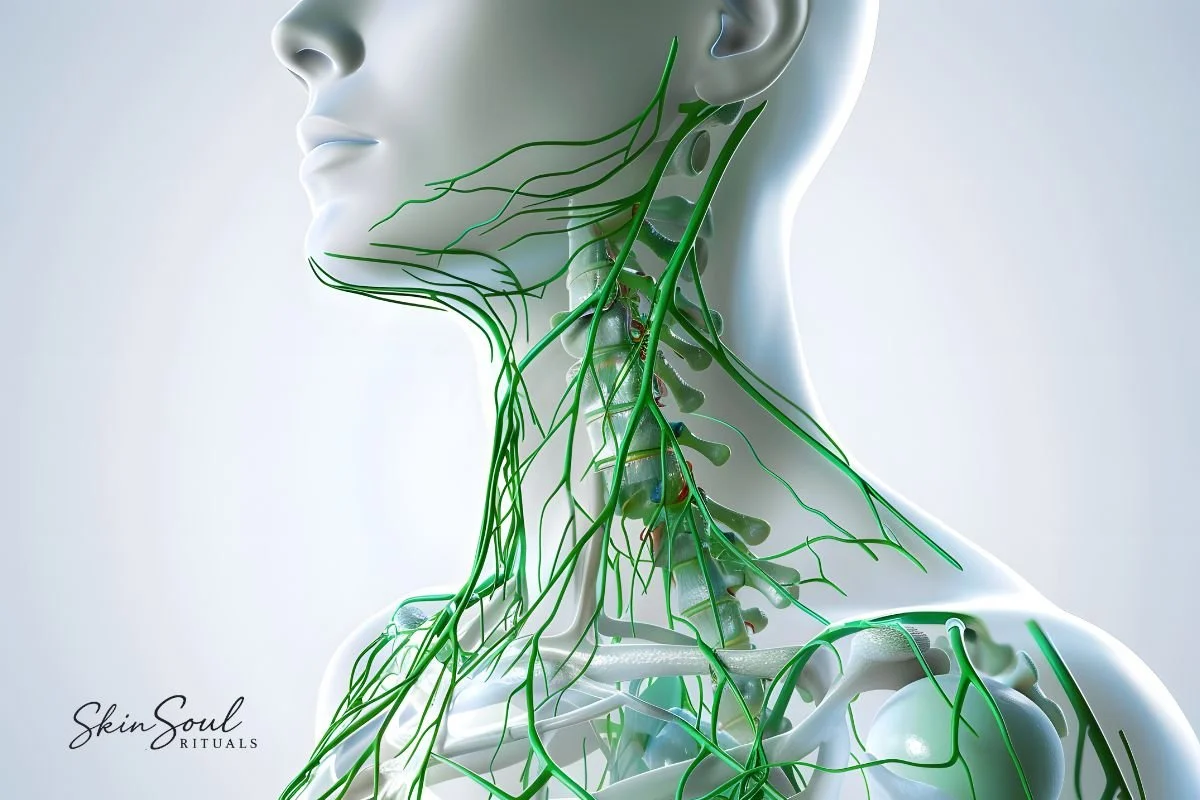
Your lymphatic system is a network of vessels and nodes that runs throughout your entire body, sitting just beneath your skin. Its job is to collect excess fluid, waste products, toxins, and cellular debris, filter them through lymph nodes, and eventually return the cleaned fluid back into your bloodstream.
Think of it like your body's drainage and waste management system. When it's working efficiently, everything flows smoothly. When it gets sluggish or overwhelmed, fluid starts to accumulate, and your face is one of the first places you'll notice it.
Why facial puffiness happens:
Gravity and sleep position: When you lie flat all night, fluid naturally accumulates in your face because gravity isn't helping drain it downward. This is why morning puffiness is so common.
Hormonal fluctuations: Estrogen and progesterone affect fluid retention. During perimenopause, menopause, or even just different phases of your menstrual cycle, you might notice more facial swelling.
High sodium intake: Eating salty foods causes your body to retain water, and that extra fluid shows up as puffiness, especially around your eyes and jawline.
Stress and poor sleep: When you're stressed or not sleeping well, your lymphatic system doesn't drain as efficiently. Cortisol also contributes to inflammation and fluid retention.
Aging: As we age, our lymphatic system naturally becomes less efficient. The muscle tone in our face decreases, and the vessels don't pump fluid as effectively.
Dehydration: Counterintuitively, not drinking enough water makes your body hold onto fluid, leading to puffiness.
Sinus congestion or allergies: Inflammation in your sinuses can block lymphatic drainage pathways, causing facial swelling.
Here's the key thing to understand: your lymphatic system doesn't have a pump like your circulatory system has your heart. It relies on muscle movement, breathing, and manual stimulation to move fluid along. This is where gua sha comes in.
How Gua Sha Supports Lymphatic Drainage
Gua sha is an ancient Chinese healing technique that uses a smooth-edged tool to massage the skin with gentle, directional strokes. When used specifically for lymphatic drainage, those strokes follow the natural pathways of your lymphatic vessels, encouraging stagnant fluid to move toward your lymph nodes where it can be filtered and drained.
Here's what happens when you do lymphatic gua sha:
You manually pump the lymphatic vessels: Since your lymphatic system doesn't have its own pump, the gentle pressure and gliding motion of the gua sha tool acts like a manual pump, pushing fluid along the vessels.
You open drainage pathways: By starting at your neck (where major lymph nodes are located) and working systematically, you're essentially "opening the drain" so fluid from your face has somewhere to go.
You reduce inflammation: The massage stimulates circulation, which brings fresh oxygenated blood to the area while carrying away inflammatory waste products.
You release facial tension: Tight muscles in your face and jaw can compress lymphatic vessels, blocking drainage. Gua sha releases that tension, allowing vessels to function properly.
You activate your parasympathetic nervous system: The slow, intentional movements signal to your body that it's safe to relax, which actually improves lymphatic flow. Stress constricts vessels; relaxation opens them.
In my treatment room, I've watched clients' faces visibly transform during a lymphatic drainage gua sha session. Puffy under-eyes smooth out, jowls lift, and that "heavy" feeling disappears. But the key is technique, random scraping won't do it. You need to follow your lymphatic pathways.
The Correct Gua Sha Technique for Lymphatic Drainage
This is where most people get it wrong. I see so many videos on social media showing people scraping their faces in random directions, pressing way too hard, or skipping the most important steps. Let me walk you through the proper technique.
What you'll need:
A smooth gua sha stone with curved edges that fit your facial contours
A nourishing facial oil for smooth gliding—never work on dry skin
If you're just getting started, our Glow & Lift Kit includes a professional-grade gua sha stone and our signature Glow Elixir facial oil, the same tools I use, designed specifically for lymphatic drainage and facial work.
Critical technique principles:
Pressure: Lymphatic vessels sit very close to the surface of your skin. You need LIGHT pressure, lighter than you think. If you're pressing hard enough to see significant redness or feel discomfort, you're going too deep and missing the lymphatic layer entirely. Think "gentle glide," not "deep tissue massage."
Direction: Always move fluid TOWARD your lymph nodes. For your face, that means moving DOWN the neck, OUT toward your ears, and UP from your jaw to your cheekbones. Never scrape back and forth or in random directions. Lymph flows toward the heart.
Speed: Slow and intentional. Each stroke should take 3-5 seconds. You're encouraging gentle drainage, not frantically scraping.
Sequence: Always start by opening your drainage pathways (neck and chest) FIRST, then work on your face. If you don't open the drain, you're just moving fluid around with nowhere for it to go.
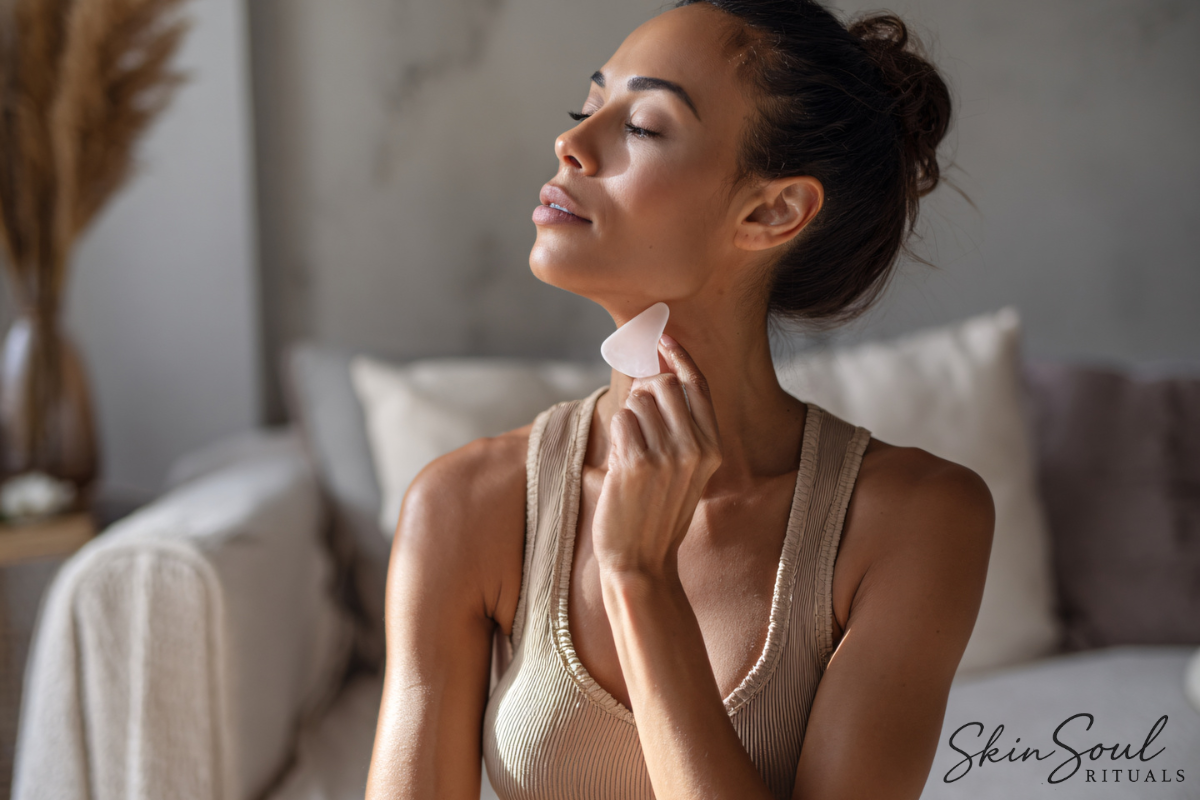
The Complete Lymphatic Drainage Gua Sha Routine
Here's the exact routine I teach my clients. Follow this sequence in order, the order matters for effective drainage.
Step 1: Prepare your drainage pathways (2 minutes)
This is the most important step that everyone skips. You need to open your lymph nodes before you start moving fluid from your face.
Sit or stand comfortably. Take three slow, deep breaths, deep breathing actually stimulates lymphatic flow throughout your body.
Place the flat edge of your gua sha tool at the center of your chest, just below your collarbones. Using very light pressure, sweep downward toward your heart. Repeat 3-5 times. This opens the thoracic duct, where all the lymph from your head and neck eventually drains.
Now move to your neck. Starting just below your ear, glide the tool straight down the side of your neck toward your collarbone. Use long, smooth strokes. Repeat 3-5 times on each side. You're opening the cervical lymph nodes and creating a pathway for facial fluid to drain.
Step 2: Drain under-eye puffiness (1-2 minutes)
Apply your facial oil generously around your eyes, this area is delicate and needs plenty of slip.
Place the flat or gently curved edge of your tool at the inner corner of your under-eye area (near your nose). With the lightest possible pressure, sweep outward toward your temple and all the way to your hairline. Imagine you're gently pushing fluid out and away. Repeat 3-5 times under each eye.
For the upper eyelid and brow bone, start at the inner brow and sweep outward toward your temple. This helps with puffy eyelids and that heavy feeling above your eyes. Repeat 3-5 times on each side.
Step 3: Sculpt and drain the cheeks (1-2 minutes)
Start at the side of your nose, right where your cheek begins. Using the curved edge of your tool, glide upward and outward along your cheekbone toward your ear. You're following the natural contour of your cheek. This drains fluid while also lifting and sculpting. Repeat 3-5 times on each side.
For the lower cheek area (where jowling can happen), start at the corner of your mouth and sweep upward toward your ear. This helps drain fluid that settles in the lower face. Repeat 3-5 times on each side.
Step 4: Define the jawline (1-2 minutes)
Place the curved notch of your tool at the center of your chin. Glide along your jawbone toward your ear, following the natural line of your jaw. This is one of the most satisfying moves, you can feel fluid moving and tension releasing. Repeat 3-5 times on each side.
For extra de-puffing, you can also work from just under your jawline (the soft area of your neck) and sweep downward toward your collarbone. This helps drain any fluid pooling under your jaw. Repeat 3-5 times on each side.
Step 5: Smooth the forehead (1 minute)
Start in the center of your forehead between your eyebrows. Sweep outward toward your temple and hairline. Work in horizontal sections—center to temple, just above that, then higher, until you've covered your entire forehead. Repeat 3-5 times across each section.
Step 6: Finish by draining the neck (1 minute)
End exactly where you started, at your neck. From below your ear, sweep straight down toward your collarbone. Repeat 3-5 times on each side. This completes the drainage circuit and ensures all the fluid you've moved from your face has somewhere to go.
The entire routine takes 5-10 minutes. You should feel immediate lightness in your face, and your skin should look brighter and less puffy right away.
When and How Often to Do Lymphatic Drainage Gua Sha
Best times to practice:
First thing in the morning: This is when most people are puffiest after lying flat all night. Doing lymphatic drainage gua sha right after you wake up can dramatically reduce morning puffiness.
Before important events: If you have a presentation, date, or photo opportunity and want to look your most sculpted and glowing, do a quick session 30 minutes before.
In the evening as a wind-down ritual: While morning is ideal for depuffing, evening gua sha can help you relax, release the day's tension, and support overnight drainage.
Whenever you feel puffy: After a salty meal, during your menstrual cycle, when you're stressed or anytime you notice extra facial swelling.
How often:
For general maintenance and gradual improvement, 3-5 times per week is ideal. If you're dealing with chronic puffiness, you can safely do this daily. The key is consistency, your lymphatic system responds better to regular gentle stimulation than occasional intense sessions.
What Results to Expect and When
Let me set realistic expectations so you're not disappointed or give up too soon. Here are my own results from 6 weeks of consistent lymphatic drainage gua sha practice:
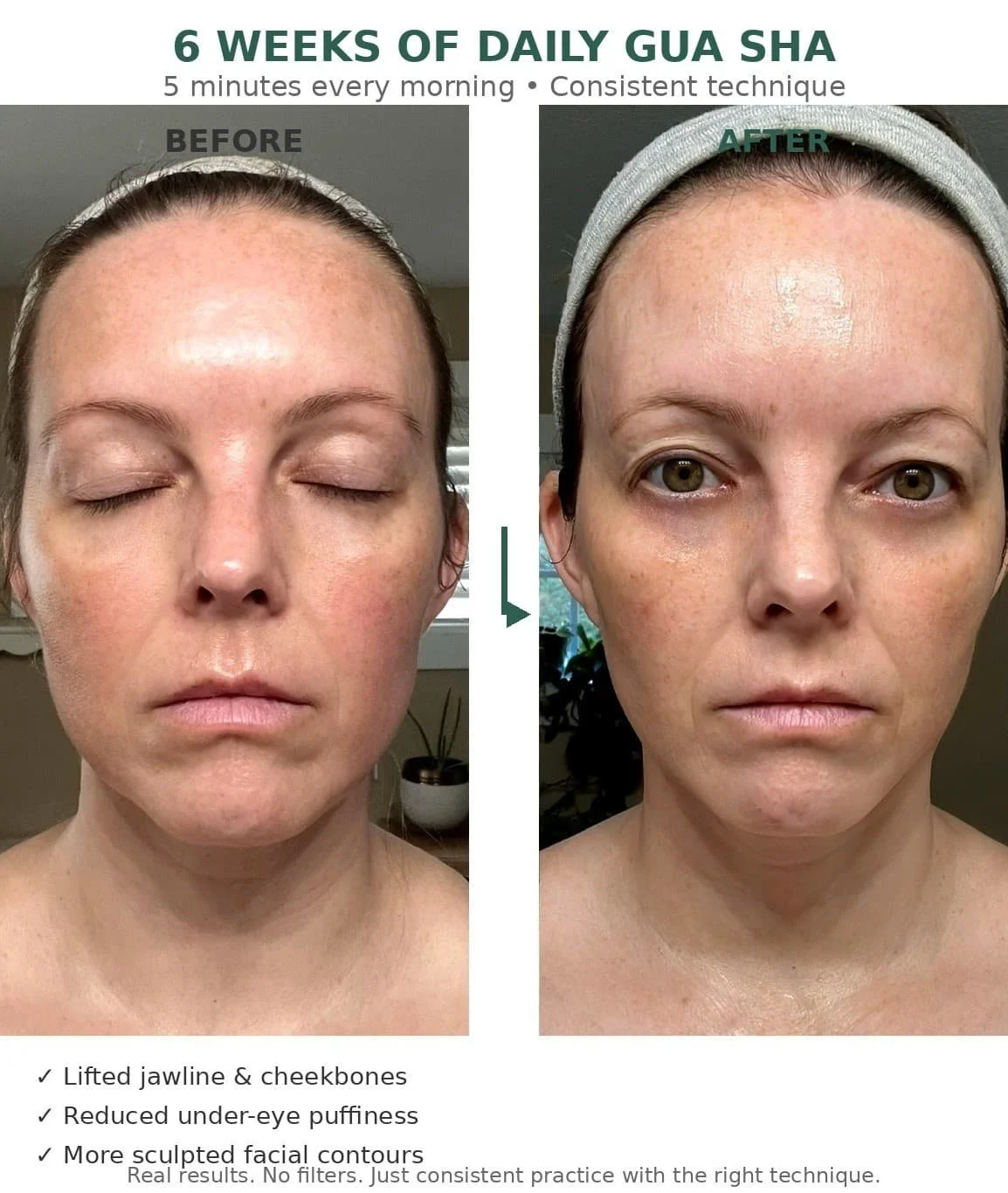
My personal 6 weeks results. I didn’t realize my face was so puffy.
You can see the reduction in overall facial puffiness, more defined jawline and cheekbones, and that "lifted" appearance that comes from effective lymphatic drainage. This didn't happen overnight, it was the result of showing up 5-6 days per week for six weeks. But here's what you can expect at different stages:
Immediately after each session:
Visibly less puffiness, especially under eyes and along jawline
Face feels lighter and less "heavy"
Skin looks brighter and more radiant
Jawline and cheekbones appear more defined
Tension in face and jaw feels released
These immediate results will fade somewhat over the next few hours as your body goes about its day. That's normal.
After 1-2 weeks of consistent practice:
Morning puffiness doesn't come back as intensely
You start to look more "awake" and refreshed naturally
Under-eye bags reduce noticeably
Sinus congestion may improve (the drainage helps!)
After 4-6 weeks:
Your baseline face looks more sculpted and less puffy overall
The results from each session last longer throughout the day
Your lymphatic system becomes more efficient at draining on its own
Skin texture improves from better circulation and oxygenation
Long-term (2-3 months+):
Consistent facial sculpting and definition
Significantly reduced chronic puffiness
Improved skin tone and radiance
Better response to your skincare products (better absorption and circulation)
The key is that lymphatic drainage isn't a one-time fix, it's a practice. Just like going to the gym, you don't work out once and stay fit forever. But the more consistently you support your lymphatic system, the better it functions overall.
Common Mistakes That Block Drainage (And How to Avoid Them)
After years of teaching gua sha, these are the mistakes I see most often:
Pressing too hard: Remember, lymphatic vessels are superficial. Deep pressure bypasses them entirely and can actually burst capillaries in your face. Always use gentle, light pressure.
Skipping the neck: I cannot stress this enough, if you don't open your drainage pathways at the neck first, you're just pushing fluid around your face with nowhere for it to go. Always start and end at the neck.
Random directions: Lymph only flows in specific pathways. Scraping every which way doesn't work. Follow the sequence and directions I outlined above.
Using dry skin: Without oil, you'll drag and pull your skin, which can cause irritation, broken capillaries, and even premature wrinkles. Always use plenty of facial oil for slip.
Being inconsistent: Doing this once a month won't give you results. Your lymphatic system needs regular encouragement to stay efficient.
Working over active breakouts or inflamed skin: If you have active acne, rosacea flares, or other inflammation, skip those areas. You don't want to spread bacteria or irritate inflamed skin further.
Expecting face-changing transformation: Gua sha supports your natural structure, it doesn't restructure your bones or permanently change your face shape. It reveals your best version by reducing puffiness and releasing tension.
Lifestyle Factors That Support Lymphatic Drainage
Gua sha is incredibly effective, but it works best when combined with lifestyle practices that support your lymphatic system overall:
Stay hydrated: Drink plenty of water throughout the day. Counterintuitively, dehydration makes you more puffy because your body holds onto fluid.
Reduce sodium intake: Especially in the evening. High-salt meals before bed will guarantee morning puffiness.
Move your body: Exercise, walking, even gentle stretching helps pump your lymphatic system throughout your body.
Practice deep breathing: Deep diaphragmatic breaths create internal pressure changes that stimulate lymphatic flow.
Sleep with your head slightly elevated: Using an extra pillow can help prevent fluid from pooling in your face overnight.
Manage stress: Chronic stress constricts vessels and slows drainage. Find practices that help you genuinely relax.
Avoid alcohol before bed: Alcohol causes dehydration and inflammation, both of which contribute to morning puffiness.
Who Should Avoid or Modify Lymphatic Drainage Gua Sha
While facial gua sha is generally safe for most people, there are some situations where you should skip it or consult a healthcare provider first:
Avoid gua sha if you have:
Active skin infections or open wounds on your face
Severe acne or rosacea flares (wait until it calms down)
Recent facial surgery or cosmetic procedures (wait until fully healed—usually 4-6 weeks, but check with your provider)
Blood clotting disorders or if you're on blood thinners (consult your doctor)
Diagnosed lymphedema or other lymphatic conditions (work with a certified lymphatic therapist)
Use caution and lighter pressure if you have:
Very sensitive skin or conditions like eczema
Broken capillaries or very thin skin
Recent Botox or fillers (wait at least 2 weeks, be very gentle, avoid injection sites)
Pregnant women: Lymphatic drainage is generally safe during pregnancy, but check with your healthcare provider first, especially if you have any pregnancy complications.
When in doubt, consult with a healthcare professional who understands both gua sha and your specific health situation.
The Mind-Body Connection of Lymphatic Drainage
Here's something I've observed after years of practicing and teaching gua sha: the benefits go beyond the physical depuffing.
There's something deeply calming about taking 5-10 minutes to touch your own face with intention, to slow down, to breathe deeply, and to care for yourself. That nervous system regulation, the shift from stressed "fight or flight" to relaxed "rest and digest", is when your lymphatic system actually works best.
Many of my clients tell me that their gua sha practice has become less about chasing perfect cheekbones and more about creating a moment of peace in their day. And interestingly, when they approach it from that place of care rather than criticism, they often see better results. Your body responds to kindness.
The puffiness in your face isn't your enemy or something to punish away with aggressive scraping. It's your body asking for support, for movement, for drainage. Gua sha is how you lovingly provide that support.
Final Thoughts
If you struggle with facial puffiness, under-eye bags, or that heavy, swollen feeling in your face, lymphatic drainage gua sha offers a natural, effective way to support your body's own drainage system. It's not magic, and it's not a permanent fix but it is a powerful practice that can transform how you look and feel when done consistently and correctly.
Your lymphatic system is working hard every single day to keep you healthy, filter toxins, and manage fluid balance. Sometimes it just needs a little help, especially as we age or navigate hormonal changes. Gua sha is that help, a gentle, intentional way to partner with your body's natural wisdom.
If you're willing to show up consistently for 5-10 minutes several times a week, I believe you'll be genuinely amazed by how much lighter, brighter, and more sculpted your face can look.
Ready to Start Your Lymphatic Drainage Journey?
New to gua sha? Join our free 5-Day Gua Sha Challenge where I'll teach you the fundamentals of proper technique, including a complete lymphatic drainage routine. You'll get daily video tutorials and practice sequences delivered straight to your inbox so you can master this powerful practice step-by-step.
Ready to get started today? Our Glow & Lift Kit includes everything you need: a professional-grade gua sha stone and our nourishing Glow Elixir facial oil, the exact tools I used to develop and refine the lymphatic drainage techniques I've shared here.