

Why Your Skincare Stopped Working in Your 40s
If you've looked in the mirror lately wondering why your favorite moisturizer doesn't work anymore, why your serum just sits on top of your skin, or why your cleanser leaves you tight and stripped, you're not imagining it. Your skin has changed. In your 40s, perimenopause triggers rapid hormonal shifts that fundamentally alter your skin's structure and needs. The products that worked at 35 can't solve the problems your skin has at 45 because those problems are biologically different. You're losing collagen fast (30% in the first 5 years), your barrier is weaker, cell turnover has slowed, and you're producing less natural hydration. This isn't gradual aging, this is your hormones and the good news? There is a clear easy path to adjust your routine to meet your skin’s needs now.
By Amber Boone, Licensed Aesthetician & Founder of Skin Soul Rituals
If you've looked in the mirror lately and thought, "What happened? My moisturizer used to work. My serums used to make my skin glow. Now... nothing," you're not imagining it.
Your favorite products didn't suddenly become ineffective. Your skincare routine didn't fail you randomly.
Something changed. And that something is more than likely related to hormonal changes that come along with perimenopause.
What Happened? Why Did My Skincare Stop Working?
Here's what probably happened:
The cleanser that kept your skin balanced now leaves it tight and stripped.
The moisturizer that used to last all day now absorbs in an hour and your skin still feels dry.
The serum that gave you that glow? It sits on top of your skin and feels like its doing nothing.
The exfoliator that smoothed your texture now irritates and reddens your skin.
You've tried buying more expensive products. You've layered on extra hydration.
And nothing works the way it used to.
Here's the truth that the beauty industry doesn't want to talk about…
This Isn't Aging, This Is Hormonal
Most "anti-aging" skincare is not designed for this.
Your skin in your 40s isn't gradual aging and can sometimes feel like its changed overnight.
It's perimenopause. And perimenopause is hormonal, not chronological.
Here's what that means:
When you were in your 20s and 30s, estrogen was quietly doing a lot of heavy lifting for your skin:
Producing natural oils that kept your barrier strong
Stimulating collagen production to keep skin firm
Helping your skin retain water and stay plump
Supporting cell turnover to keep skin smooth and bright
Regulating oil production to keep skin balanced
Then, somewhere in your late 30s or early 40s, estrogen levels start to fluctuate and decline. Not gradually. Erratically.
Some days high, some days low, all over the place, until eventually, they settle at much lower levels than before.
And when estrogen drops, all those functions it was quietly handling? They drop too.
The 4 Skin Changes That Make Your Products Stop Working
I’m breaking down exactly what's happening and why the products that used to work don't anymore.
Change #1: Your Skin Barrier Is Weaker (Why Your Moisturizer Doesn't Work Anymore)
Think of your skin barrier like a brick wall. The "bricks" are skin cells, and the "mortar" holding them together is made of natural oils (lipids, ceramides, cholesterol).
Estrogen helps your skin produce that mortar.
When estrogen drops, your skin produces less of it. The mortar weakens. The wall develops gaps.
This is why:
Your moisturizer absorbs quickly but your skin feels dry an hour later (the moisture is escaping through the gaps)
Products that never bothered you now sting or burn (irritants are getting through the weak barrier)
Your skin feels sensitive to everything, the weather, fabrics, ingredients (your barrier can't protect you like it used to)
What your old routine was doing: Sitting on top of a strong barrier, adding a little extra hydration.
What your skin needs now: Barrier repair. Not just hydration but actual lipid replenishment to rebuild that mortar.
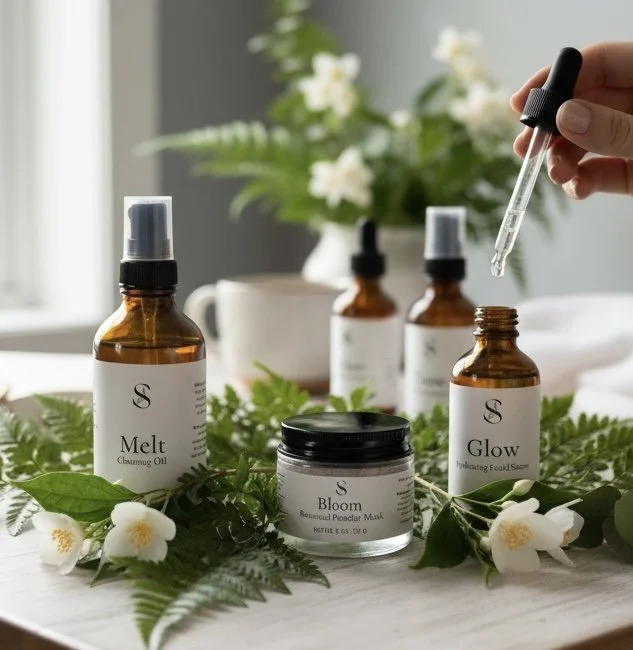
What works: Oil-based cleansers that don't strip your barrier (like Melt), hydrating mists that prep skin (like Dew), and nourishing facial oils that replace lost lipids (like Glow).
Change #2: You're Losing Collagen Fast (Why Your Serums Don't Firm Anymore)
Here's the number that matters:
In the first 5 years of perimenopause and menopause, women lose approximately 30% of their skin's collagen.
Not 30% over your lifetime. 30% in 5 years.
After that, you continue losing about 2% per year.
This is rapid structural change. Not simply gradual aging.
This is why:
Fine lines that used to appear only when you smiled are now visible all the time
Your skin feels thinner, more fragile, less resilient
Firmness is disappearing and jowls appear, skin starts to sag
Your "anti-aging" serum that worked at 35 barely makes a dent now
What your old routine was doing: Maintaining collagen levels that were naturally strong.
What your skin needs now: Collagen stimulation, but gentle stimulation that won't damage your weakened barrier.
What works: Bakuchiol (the gentle retinol alternative that stimulates collagen without irritation, like in Renew) paired with barrier-supporting oils, not harsh retinol that strips your already-fragile skin.
Change #3: Your Cell Turnover Has Slowed Way Down (Why Exfoliators Don't Brighten Anymore)
When you were younger, your skin renewed itself about every 28 days.
In your 40s and beyond, that can stretch to 40-60 days and sometimes longer.
Dead skin cells stick around longer. New, fresh cells take longer to reach the surface.
This is why:
Your skin looks dull, even when you moisturize
Texture feels rough or uneven
Products seem to sit on top of your skin instead of absorbing
Your old exfoliator (that used to reveal glowing skin) now just irritates without results
What your old routine was doing: Speeding up a naturally fast process.
What your skin needs now: Gentle enzymatic exfoliation that works WITH your slower turnover, not harsh scrubs or acids that damage your barrier.
What works: Clay and botanical-based masks with natural enzymes (like Bloom's blend of marshmallow root, calendula, rose, hibiscus, and gentle clays) plus tremella mushroom for deep hydration while you exfoliate.
Change #4: You're Producing Less Natural Hydration (Why Everything Feels Dry)
Estrogen helps your skin produce hyaluronic acid naturally. The molecule that holds up to 1,000 times its weight in water.
When estrogen drops, your skin produces less of it.
You're also producing fewer natural oils (sebum), which means your skin can't seal in the hydration it does get.
This is why:
Your skin feels chronically dry no matter how much moisturizer you apply
You wake up with dry, flaky patches that never used to be there
Makeup doesn't sit right, it emphasizes texture and dryness
You're constantly reaching for lip balm, hand cream, body lotion
What your old routine was doing: Adding a little extra moisture to skin that was already well-hydrated.
What your skin needs now: Deep hydration PLUS a way to seal it in (because your skin can't do it on its own anymore).
What works: Layering water-based hydration (like Dew's rose hydrosol, aloe, and glycerin) with oil to lock it in (like Glow's calendula-rose infused jojoba and rosehip). Tremella mushroom (nature's hyaluronic acid) also helps, it holds up to 500x its weight in water and is in Bloom.
Why the "Just Use Stronger Actives" Advice Makes It Worse
Here's what probably happened when you noticed your skin changing:
You went to a dermatologist, or read an article, or asked for advice and someone told you:
"Use stronger actives. More retinol. More acids. Exfoliate more. Fight the aging harder."
So you did. And your skin got worse.
Redder. Drier. More irritated. More sensitive.
You thought, "Maybe I need to push through? Maybe my skin needs to adjust?"
But it didn't adjust. It just got more reactive.
Here's why that advice fails perimenopausal skin:
Those "anti-aging" actives were designed for skin with a strong barrier.
Your barrier is now thinner, weaker, and more fragile.
Harsh retinol, glycolic acid, strong exfoliants, they strip your barrier further.
They damage the very thing your skin is desperately trying to protect.
You don't need stronger products. You need different products.
Products that work WITH your changing skin, not against it.
Products that rebuild your barrier while gently supporting collagen.
Products that hydrate deeply AND seal that hydration in.
Products made for hormonal skin changes that meet you where you are now. A simple, effective botanical routine.
What Your Skin Actually Needs Now
If your skincare stopped working, it's not because you need to try harder.
It's because your skin's needs have fundamentally changed.
Here's what works now:
1. Gentle, Oil-Based Cleansing
Your weakened barrier can't handle harsh, foaming cleansers anymore.
You need oil-based cleansers that:
Remove makeup and sunscreen without stripping your natural oils
Emulsify with water (so they rinse clean without residue)
Nourish your skin while cleansing
What this looks like: Melt, an oil cleanser with macadamia nut oil, meadowfoam seed oil, sunflower seed oil, and vitamin E. It melts away makeup and impurities, then emulsifies into a milky texture that rinses clean—all while nourishing your barrier, not stripping it.
Why it works: Oil dissolves oil. You're balancing your skin, not fighting it.
2. Hydration That Actually Stays (Not Just Surface Moisture)
Your skin can't hold onto water like it used to.
You need:
Water-based hydration to plump skin
A way to seal that hydration in (because your skin doesn't produce enough oil to do it naturally)
What this looks like:
Step 1: Dew, a hydrating mist with rose hydrosol, aloe, and vegetable glycerin. It delivers botanical hydration that preps your skin to receive treatment products.
Step 2: Glow, a nourishing facial oil with jojoba (infused with calendula and rose), rosehip, and vitamin E. It seals in all that hydration and replaces the lipids your skin isn't producing anymore.
Why it works: You're layering water and oil—the way your skin used to do naturally before estrogen declined.
3. Gentle Collagen Stimulation
You're losing collagen fast. You DO need to stimulate collagen production.
But you need to do it WITHOUT damaging your fragile barrier.
You need:
Bakuchiol (the gentle retinol alternative that stimulates collagen without irritation)
Nourishing oils that support your barrier while the bakuchiol works
What this looks like: Renew, a bakuchiol serum with 1% bakuchiol in a base of squalane, jojoba, rosehip, macadamia nut, meadowfoam, and sea buckthorn oils. Plus vitamin E, frankincense, and jasmine.
Why it works: Bakuchiol delivers the collagen-boosting benefits of retinol without the peeling, redness, or irritation. It works WITH your barrier, not against it.
4. Gentle Exfoliation + Deep Hydration
Dead skin cells are sticking around longer. You need exfoliation.
But harsh scrubs and strong acids will damage your barrier.
You need:
Gentle clay-based exfoliation that detoxifies without stripping
Botanical enzymes that dissolve dead skin cells (not scrub them off)
Deep hydration AT THE SAME TIME (because your skin is dry!)
What this looks like: Bloom, a powder mask you mix with water. It contains:
White kaolin clay and French pink clay (gentle detoxification)
Marshmallow root, calendula, rose petal, and hibiscus (calming botanicals)
Tremella mushroom (nature's hyaluronic acid—holds up to 500x its weight in water!)
Why it works: You're exfoliating gently while flooding your skin with hydration. You're renewing AND nourishing at the same time.
The Simple 3-Step Routine w/weekly exfoliation 1/2 x’s
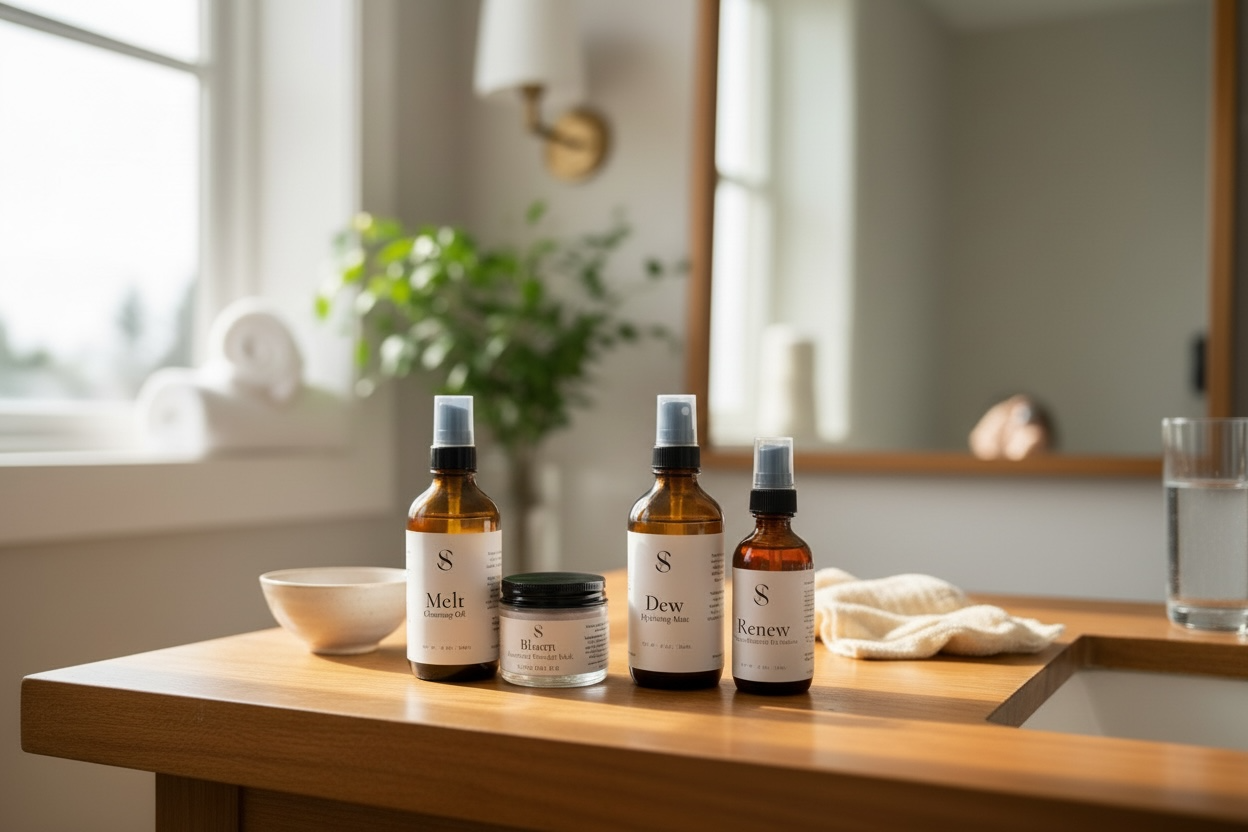
The Simple Routine That Actually Works for Perimenopausal Skin
If your tired of guessing what will work for your skin. Here's the routine:
MORNING:
Cleanse: Melt (oil cleanser—nourishes while cleansing)
Hydrate: Dew (rose hydrosol mist—preps and plumps)
Treat: Renew (bakuchiol serum—gentle collagen boost)
Seal: Glow (facial oil—locks in hydration, replaces lipids)
Protect: SPF 30+ (mineral sunscreen is gentler)
EVENING:
Same routine (skip the SPF)
WEEKLY (1-2x):
Bloom powder mask (gentle exfoliation + deep hydration with tremella mushroom)
That's it.
No 10-step routine. No harsh actives. No fighting your skin.
Just simple, effective support for what your skin actually needs now.
If You Have Very Sensitive Skin
If your skin has become highly reactive during perimenopause, start even simpler:
Melt, Dew & Calm: Melt, a barrier repair oil cleanser, Dew, a hydrating mist that will soothe irritation (only 4 ingredients) and Calm a soothing serum to calm and heal with only 2 ingredients designed for inflammation and redness.
Perimenopause can make skin incredibly sensitive. Sometimes you need to strip it all back and start with the absolute gentlest option.
Common Questions About Perimenopause Skincare
Q: How do I know if my skin changes are perimenopause or just aging?
A: If you're in your 40s and you've noticed sudden changes such as dryness that appeared seemingly overnight, products that used to work suddenly don't, increased sensitivity, texture changes, that's perimenopause.
Gradual aging happens slowly over decades. Perimenopause skin changes happen in a few years (sometimes months). The speed of change is the giveaway.
Q: Will my skin ever feel "normal" again?
A: Your skin will adapt and stabilize after menopause (when hormone levels settle at a new baseline). But "normal" means something different now.
With the right support, and products made FOR hormonal skin, your skin can feel comfortable, hydrated, and healthy again. Just not in the same way it did at 30. But that’s okay. We want to look our best not necessarily younger.
Q: Can I still use retinol?
A: If your barrier is strong and you've been using retinol for years with no issues, you might be able to continue, but watch for increased sensitivity.
If you're new to retinol or your skin has become sensitive, bakuchiol is the better choice. It stimulates collagen without the irritation, peeling, or barrier damage that retinol causes. It’s my new favorite.
Q: How long until I see results?
A: Barrier repair: 1-2 weeks (skin will feel more comfortable, less tight)
Hydration improvement: 2-3 weeks (plumper, dewier skin)
Collagen stimulation: 4-6 weeks (smoother texture, improved firmness)
Give your skin time. It took months for these changes to develop. Healing takes time too.
Q: Do I really need oil if my skin is oily?
A: Yes. Even if your skin is oily, it's likely dehydrated during perimenopause.
Your skin might be overproducing oil to compensate for the weak barrier and lack of moisture. Adding the right oil (like jojoba, which mimics your skin's natural sebum) can actually balance oil production. Trust me on this one. I know it seem contradicting.
Q: What about diet, sleep, and lifestyle?
A: Absolutely crucial. Your skin is an organ, and it responds to how you care for your whole body.
Sleep: Skin repairs itself at night. 7-8 hours minimum.
Hydration: Drink half your body weight in ounces of water daily.
Stress: Cortisol breaks down collagen. Manage stress actively.
Nutrition: Omega-3s, antioxidants, collagen-building foods matter.
Movement: Circulation = glow. Even 20-minute walks help.
Skincare can't fix internal dehydration, chronic stress, or poor sleep. So make sure your also supporting your skin from the inside out.
The Bottom Line
If your skincare stopped working in your 40s, you didn't do anything wrong.
You're not "bad at skincare."
Your skin changed. Biologically. Structurally. At a cellular level.
The products that worked at 35 can't solve the problems your skin has at 45, because those problems are fundamentally different.
You don't need to fight your skin. You need to support it.
You don't need "anti-aging” skincare. You need perimenopause-specific skincare.
You don't need 10 steps and harsh actives. You need simple, gentle, targeted support:
Barrier repair (oil cleansing, lipid replenishment)
Deep hydration (water + oil layering)
Gentle collagen stimulation (like bakuchiol, sea buckthorn)
Gentle exfoliation + hydration (clay and botanicals with tremella)
Want to hear me walk through this in person? I made a whole video on this exact topic, come hang out:
Ready to Give Your Skin What It Actually Needs?
I created The Skin Reset Collection and it gives you everything you need for perimenopausal skin:
Melt (oil cleanser—nourishes while cleansing)
Dew (hydrating mist—preps and plumps)
Renew (bakuchiol serum—gentle collagen boost)
Bloom (powder mask with tremella—gentle renewal + deep hydration)
Add Glow & Lift Kit (facial oil + gua sha tool) for the final step that promotes circulation and seals in all that hydration and replaces lost lipids.
If your skin is highly sensitive, start with Calm (two-ingredient serum that soothes with just calendula + jojoba).
Shop:skinsoulrituals.com
Subscribe on YouTube:@skinsoulrituals
Sign up to get new blog posts delivered to your inbox: https://skinsoulrituals.myflodesk.com/blog
With Gratitude & Good Skin Days,
Amber, Licensed Holistic Aesthetician (13+ years)
Skin Soul Rituals
Bakuchiol vs Retinol: The Gentle, Natural Alternative for Anti-Aging Skin
If you've been told retinol is the gold standard for anti-aging but your skin can't tolerate the redness, peeling, and sensitivity it causes, there's a gentler path forward. Bakuchiol is a plant-derived ingredient that delivers many of retinol's benefits, smoother texture, reduced fine lines, improved firmness without the harsh side effects. As a holistic aesthetician who's spent 13 years working with sensitive, mature skin, I'm sharing everything you need to know about bakuchiol vs retinol so you can choose the right ingredient for your skin.
By Amber Boone, Holistic Aesthetician & Founder of Skin Soul Rituals
If you've spent any time researching anti-aging skincare, you've been told that retinol is the gold standard. The one ingredient dermatologists universally recommend. The proven wrinkle-fighter backed by decades of research.
And it's true, retinol works. But here's what they don't always tell you: for many people, especially those with sensitive skin, rosacea, or mature skin that's become more delicate, retinol can be incredibly harsh. The redness, the peeling, the increased sun sensitivity, the irritation that takes weeks to subside, it's a high price to pay for smoother skin.
As a licensed holistic aesthetician with 13 years of experience working with clients in their 40s, 50s, and beyond, I've watched countless women try retinol, struggle with the side effects, and eventually give up, convinced that effective anti-aging skincare just isn't for them.
But there's another option that's been quietly gaining attention in the holistic skincare world: bakuchiol. A plant-derived ingredient that delivers many of retinol's benefits without the irritation, sun sensitivity, or harsh adjustment period.
Let me break down everything you need to know about bakuchiol vs retinol so you can make an informed choice for your skin.
What Is Retinol and Why Is It So Popular?
Retinol is a derivative of vitamin A that's been used in skincare since the 1970s. It works by increasing cell turnover, stimulating collagen production, and speeding up the skin's natural renewal process.
What retinol does well:
Reduces the appearance of fine lines and wrinkles
Improves skin texture and smoothness
Fades hyperpigmentation and age spots
Unclogs pores and can help with acne
Increases collagen production for firmer skin
Backed by extensive clinical research
The science is solid. Retinol genuinely works for anti-aging. But effectiveness isn't the whole story.
The downsides of retinol:
Severe irritation during "retinization": When you first start using retinol, your skin often goes through an adjustment period that can last weeks or even months. Expect redness, peeling, flaking, dryness, and increased sensitivity.
Sun sensitivity: Retinol makes your skin more vulnerable to sun damage, requiring diligent daily SPF use and sun avoidance.
Not safe during pregnancy or breastfeeding: Vitamin A derivatives can cause birth defects, so retinol is off-limits for pregnant and nursing mothers.
Can worsen certain skin conditions: If you have rosacea, eczema, or very sensitive skin, retinol can trigger severe flares.
Requires careful layering: Using retinol with certain other active ingredients (like AHAs, BHAs, or vitamin C) can cause excessive irritation.
Inconsistent results: Some people's skin never adjusts, no matter how slowly they introduce it.
I've worked with so many clients who desperately wanted retinol to work for them but couldn't tolerate the side effects. Their skin would be red and angry for weeks, and they'd eventually stop using it, defeated and frustrated.
This is where bakuchiol enters the picture.
What Is Bakuchiol?
Bakuchiol (pronounced "bak-oo-chee-ol") is a plant-based compound extracted from the seeds and leaves of the Psoralea corylifolia plant, also known as babchi. This plant has been used in traditional Ayurvedic and Chinese medicine for centuries to treat various skin conditions.
But bakuchiol only started gaining attention in Western skincare around 2018-2019 when clinical studies began showing it could deliver retinol-like benefits without retinol-like irritation.
Here's what makes bakuchiol different from retinol:
Plant-derived: It comes from a botanical source, not synthesized vitamin A.
Gentle on skin: Clinical studies show minimal to no irritation, even for sensitive skin types.
No sun sensitivity: Unlike retinol, bakuchiol doesn't increase your skin's vulnerability to UV damage (though you should still wear SPF!).
Safe during pregnancy: While you should always check with your healthcare provider, bakuchiol is generally considered safe for pregnant and breastfeeding women since it's not a vitamin A derivative.
Works differently at the molecular level: Bakuchiol and retinol don't have the same chemical structure, but they produce similar results through different mechanisms.
Can be used morning or night: Retinol should only be used at night due to sun sensitivity; bakuchiol can be used any time.
Plays well with other actives: You can layer bakuchiol with vitamin C, AHAs, niacinamide, and other ingredients without the same risk of irritation.
Think of bakuchiol as the gentle, plant-based cousin of retinol one that delivers similar benefits through a kinder path.

Bakuchiol vs Retinol: The Science
Let's look at what clinical research actually shows about how these two ingredients compare.
The landmark 2018 study published in the British Journal of Dermatology directly compared bakuchiol and retinol in a 12-week trial. The results were remarkable:
Both groups (bakuchiol and retinol users) showed significant improvements in fine lines, wrinkles, pigmentation, elasticity, and firmness
The improvements were statistically equivalent between the two groups
The retinol group experienced significantly more scaling and stinging
The bakuchiol group reported far less irritation
How they work differently:
Retinol binds to specific receptors in your skin cells (retinoic acid receptors) and directly signals them to speed up cell turnover and increase collagen production. This aggressive signaling is effective but harsh.
Bakuchiol works through different pathways. It's an antioxidant that stimulates collagen production, regulates cell turnover, and reduces inflammation without binding to those same receptors. The gentler mechanism produces similar results with less trauma to the skin.
What bakuchiol does for your skin:
Stimulates collagen types I and III production (the same types retinol stimulates)
Reduces the appearance of fine lines and wrinkles
Improves skin firmness and elasticity
Fades hyperpigmentation and evens skin tone
Provides antioxidant protection against environmental damage
Reduces inflammation
Helps control excess oil production
The research is still emerging, but the studies we have are promising.
Who Should Use Bakuchiol Instead of Retinol?
Bakuchiol isn't just for people who "can't handle" retinol. It's a legitimate choice for anyone seeking gentler, more holistic anti-aging skincare. But it's especially well-suited for certain situations.
Choose bakuchiol if you:
Have sensitive, reactive, or rosacea-prone skin: If your skin flushes easily, reacts to many products, or you have diagnosed rosacea, bakuchiol is far less likely to trigger a flare.
Are pregnant or breastfeeding: Bakuchiol offers a way to address anti-aging concerns during a time when retinol is off-limits.
Experience hormonal skin changes: Perimenopause and menopause often bring increased skin sensitivity. Bakuchiol respects that sensitivity while still addressing aging concerns.
Can't tolerate retinol's adjustment period: Some people simply don't have the patience or tolerance for weeks of peeling and redness. That's completely valid.
Want to use actives during the day: If you prefer doing your treatment skincare in the morning, bakuchiol doesn't come with sun sensitivity concerns.
Prefer plant-based, natural skincare: If you're drawn to botanical ingredients and holistic beauty, bakuchiol aligns with that philosophy.
Have dry or dehydrated skin: Retinol can be extremely drying. Bakuchiol is much gentler on already-dry skin.
Are new to anti-aging actives: Starting with bakuchiol can be a gentler introduction before potentially trying retinol later (or not—bakuchiol may be all you need).
Who Should Stick with Retinol?
I want to be fair here. Retinol isn't the enemy, and for some people, it's still the better choice.
Retinol might be better if you:
Have very resilient, non-sensitive skin: If your skin tolerates everything and you don't experience irritation from retinol, it has decades of research backing it.
Have severe acne: While bakuchiol can help with breakouts, prescription-strength retinoids (like tretinoin) are more proven for severe acne.
Need prescription-strength treatment: Bakuchiol is available in over-the-counter products. If you need tretinoin or other prescription retinoids for medical reasons, bakuchiol won't replace that.
The truth is, both ingredients are effective. The question is which one aligns better with your skin's needs, your lifestyle, and your values.
Can You Use Bakuchiol and Retinol Together?
Interestingly, yes, though it's not necessary for most people.
Some skincare enthusiasts and formulators suggest that using bakuchiol and retinol together can enhance results while buffering retinol's irritation. The theory is that bakuchiol's anti-inflammatory properties help counteract retinol's harshness.
If you want to try this approach:
Use retinol at night (start slowly—once or twice a week)
Use bakuchiol in the morning or on retinol "off" nights
Monitor your skin closely for any irritation
This is more advanced and not necessary for beginners
My take: For most people seeking gentler anti-aging skincare, choosing one or the other makes more sense than combining them. If you're interested in bakuchiol specifically because you want to avoid retinol's harshness, just use bakuchiol on its own.
How to Use Bakuchiol in Your Routine
One of bakuchiol's biggest advantages is its simplicity. Unlike retinol's complicated introduction protocol, bakuchiol is straightforward.
Basic bakuchiol routine:
Step 1: Cleanse your face thoroughly
Step 2: Apply any hydrating mists or water-based serums (like hyaluronic acid if you use it)
Step 3: Apply your bakuchiol serum or oil
Use 2-4 drops for your entire face
Gently press and massage into skin
Focus on areas of concern (fine lines, uneven tone)
Step 4: Follow with a facial oil or moisturizer to seal everything in
Step 5: In the morning, always finish with SPF (even though bakuchiol doesn't cause sun sensitivity, UV protection is still crucial for anti-aging)
How often to use it: Unlike retinol, which you typically start using once or twice a week and slowly increase, you can use bakuchiol daily from day one. Most people use it once daily (morning or night), though some use it twice daily.
When to expect results: Clinical studies show visible improvements around 4-12 weeks of consistent use. This is similar to retinol's timeline. Be patient and consistent.
Can you layer it with other actives? Yes! Bakuchiol plays well with:
Vitamin C (great combo for brightening)
Niacinamide
Hyaluronic acid
AHAs and BHAs (though always patch test when combining actives)
Peptides
This flexibility is one of bakuchiol's major advantages over retinol.
What to Look for in a Bakuchiol Product
Not all bakuchiol products are created equal. Here's what to consider:
Concentration: Most effective bakuchiol serums contain 0.5% to 1% bakuchiol. Higher isn't always better—1% is considered the sweet spot for efficacy without waste.
Supporting ingredients: Bakuchiol works even better when formulated with complementary ingredients like:
Nourishing plant oils (jojoba, rosehip, squalane) that deliver the bakuchiol and support skin barrier function
Antioxidants (vitamin E, green tea extract) that enhance anti-aging benefits
Hydrating ingredients (hyaluronic acid, glycerin) that plump and smooth
Quality of the bakuchiol: Look for products that specify they use pure, high-quality bakuchiol extract (not just "babchi oil" which contains other compounds).
Texture and base: Bakuchiol can be formulated in different bases:
Oil-based serums and elixirs (luxurious, nourishing, great for dry/mature skin)
Water-based serums (lightweight, absorbs quickly)
Creams and moisturizers (convenient all-in-one option)
Choose based on your skin type and preference.
Packaging: Look for opaque or dark glass bottles that protect the formula from light degradation.
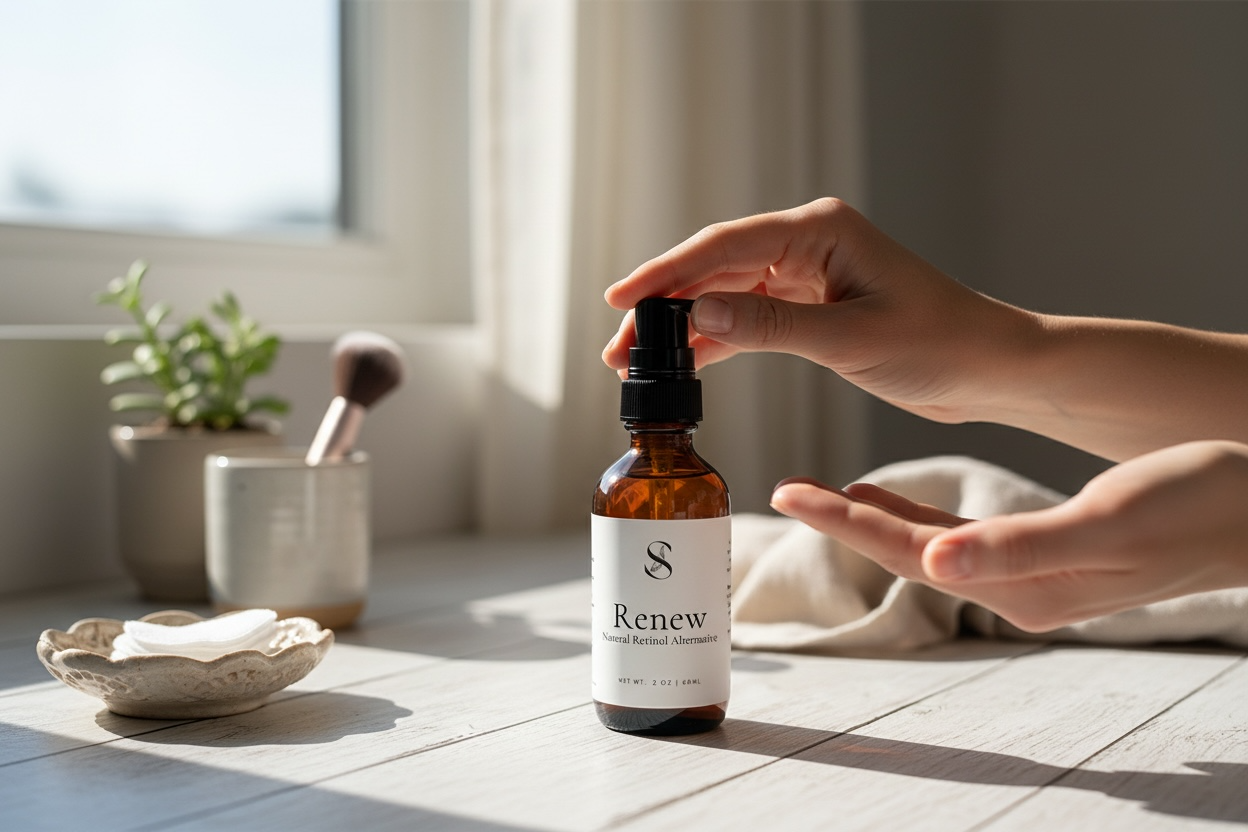
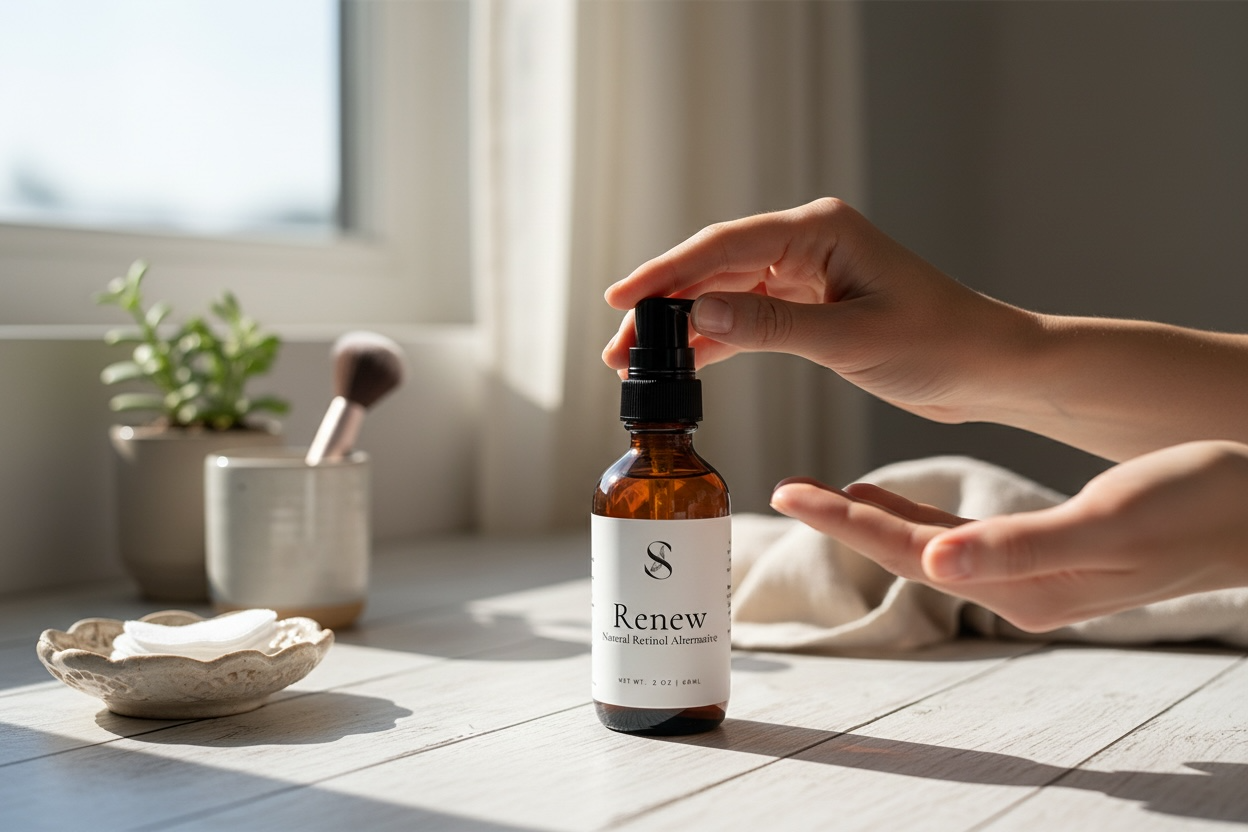
Renew, Natural Retinol Alternative
The Holistic Perspective: Why I Chose Bakuchiol
As someone who's practiced holistic aesthetics for over a decade, I've always believed that effective skincare doesn't have to be harsh. Our skin is remarkably intelligent, it knows how to heal, renew, and protect itself when given the right support.
Retinol takes an aggressive approach: force the skin to turn over faster, whether it's ready or not. And yes, that works. But it also creates inflammation, disrupts the skin barrier, and can leave skin vulnerable.
Bakuchiol takes a different approach: work with the skin's natural processes, stimulate collagen gently, provide antioxidant protection, and support, rather than force- renewal.
This aligns with everything I believe about holistic beauty:
Gentler is often more sustainable long-term
Plant-based ingredients can be just as effective as synthetic ones
Reducing inflammation is key to healthy aging
Skincare should feel nourishing, not punishing
When I formulate products for Skin Soul Rituals, I'm always asking: "What will genuinely serve the skin without causing harm?" Bakuchiol answers that question beautifully.
My Personal Experience with Bakuchiol
I started using bakuchiol after years of on-and-off struggles with retinol. My skin would improve with retinol, but the constant dryness and sensitivity felt like I was fighting my skin rather than supporting it.
Within weeks of switching to bakuchiol, I noticed:
Smoother skin texture without any peeling or flaking
Gradual fading of sun spots on my cheeks
Improved firmness, especially around my jawline
No redness or irritation
My skin felt calm and nourished
The results were comparable to what I'd seen with retinol, but the journey to get there was completely different. My skin felt healthy and happy throughout the process, not traumatized.
This personal experience, combined with my professional observations working with clients, convinced me that bakuchiol deserves a place in holistic anti-aging skincare.
The Future of Bakuchiol in Skincare
Bakuchiol is still relatively new to mainstream Western skincare, but it's gaining momentum rapidly. More brands are formulating with it, more studies are being published, and more people are discovering it works for skin that couldn't tolerate retinol.
I expect we'll see:
More clinical research confirming and expanding on current findings
Higher-quality bakuchiol formulations as brands refine their products
Increased education about bakuchiol as a legitimate retinol alternative, not just a "natural" trend
Combination products that pair bakuchiol with complementary botanicals for enhanced results
The ingredient is here to stay and for good reason.
Final Thoughts: Choosing What's Right for Your Skin
Here's the truth: both bakuchiol and retinol can be effective for anti-aging. Neither is universally "better." The right choice depends on your skin, your values, and what you're willing to tolerate.
Choose retinol if:
Your skin tolerates it well without excessive irritation
You're not pregnant/breastfeeding
You're willing to manage the adjustment period and sun sensitivity
Choose bakuchiol if:
You have sensitive, reactive, or mature skin
You want gentle, plant-based anti-aging support
You're pregnant, breastfeeding, or prefer to avoid vitamin A derivatives
You want to use actives without sun sensitivity concerns
You value holistic, inflammation-reducing skincare
For me, bakuchiol has been a revelation proof that you don't have to choose between gentle and effective. You can have both.
Your skin deserves to be treated with care, even as you ask it to look more youthful. Bakuchiol offers that possibility.
Shop Our Favorite Retinol Alternative here. If your looking for more skincare tips and advice checkout my Skin + Soul Education Hub